Thursday, October 20, 2011

Android Ice Cream Sandwich

Google and Samsung launched Galaxy Nexus, the third Nexus Smartphone, and Ice Cream Sandwich (ICS), the new Android edition that brings many of the Honeycomb features to smartphones. Ice Cream Sandwich is the first Android version that will work on smartphones, tablets and TVs, but today's launch only focused on smartphones.
http://felix-googleblog-archive.blogspot.com/

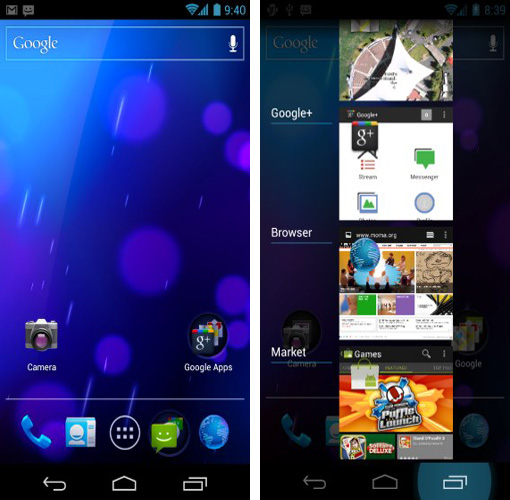
Android 4.0 brings a polished border that's more visual, more consistent and more interactive. Hardware buttons are replaced by virtual buttons in phones like Galaxy Nexus and Android 4.0 supports this change, while also allowing users to momentarily hide the buttons. Contextual menus are now displayed consistently at the top of the screen, so it's easier to find them. The menu button has been replaced by a fresh apps button that lets you switch to an app you've used recently. This feature was already accessible in Android, but the new interface uses thumbnails and it looks much better.

Just like in iOS, you can now create folders by dragging one app onto another app. You can also uninstall apps or disable pre-installed apps from the launcher. That's a good news for users because many carriers bundle applications that aren't very helpful.

Widgets are now resizable and can comprise more features, just like a regular app. The standard widgets are more powerful and you'll most likely use them more often instead of opening the corresponding apps.

You no longer have to unlock a phone to check the newest notifications, see the album art of the song that's at present playing or open the camera app. You can now react to incoming calls using text message templates and dismiss individual notifications. There's also Face Unlock, a simple way to unlock a device using facial recognition.

The soft keyboard has been enhanced and it offers better suggestions. There's a new spell-checker that underlines errors and suggests how you might fix them.

http://felix-googleblog-archive.blogspot.com/

Android's voice input engine lets you say a text without having to pause. "Users can speak continously for a extended time, even pausing for intervals if needed, and dictate punctuation to create correct sentences. As the voice input engine enters text, it underlines credible dictation errors in gray."

There's a new People app that integrates with Google+ and other social services, an updated calendar app that allows other applications to add events, visual voicemail in the phone app, a camera app that supports continuous focus, zero shutter lag exposure, stabilized image zoom, focus detection and single-motion panorama. The redesigned Gallery app focuses on functionality instead of eye-candy and makes it easier to edit photos and sort albums by time, location, people and tags.


Android lastly allows users to take screenshots without installing additional apps. The browser syncs bookmarks with Google Chrome, lets you save pages for offline reading and has an alternative to change the user agent of the browser so you can go to the desktop description of a page. Android's browser includes V8's Crankshaft update which improves JavaScript performance. "In benchmarks run on a Nexus S device, the Android 4.0 browser showed an improvement of almost 220% over the Android 2.3 browser in the V8 Benchmark Suite and more than 35% in the Sun Spider 9.1 JavaScript Benchmark." The tabs share the border used for switching to a recent app.

http://felix-googleblog-archive.blogspot.com/

The email app brings better contact auto-completion, templates, and integrated menu for accounts and labels, nested subfolders and searching across folders on the server. NFC is now used in Android Beam, a simple way to split contacts, apps, videos with compatible devices. "It's extremely simple and convenient to use — there's no menu to open, application to launch, or pairing needed. Just touch one Android-powered phone to another, then tap to send."

http://felix-googleblog-archive.blogspot.com/

The reference device for Android 4.0 is Galaxy Nexus, a Samsung smartphone that uses a 4.65" Contour Display (HD Super AMOLED) with a 1280 x 720 declaration, a dual core 1.2GHz processor and has support for LTE or HSPA+, depending on the carrier. The phone will be launched next month in the US, Canada, Europe and Asia. Obviously, you shouldn't wait for to be able to update Nexus S or other Android devices to ICS before the Galaxy Nexus launch.

http://felix-googleblog-archive.blogspot.com/


Here's a video that showcases most of the Android ICS features, followed by a Galaxy Nexus ad:


Tuesday, October 18, 2011

Extra Google Wallet merchants are live. Now you can pay AND save in a single tap.

We’re hearing from people at check-out counters throughout the country that paying with your phone is a little like magic. Just look at the ecstatic response on the faces of our friends who made their first Google Wallet purchases last Thursday.

Today, our partners American Eagle Outfitters, The Container Store, Foot Locker, Guess, Jamba Juice, Macy’s, OfficeMax and Toys“R”Us are rolling out an even improved Google Wallet experience. For the first time ever in the U.S., at these select stores, you can not only pay but also exchange coupons and/or earn rewards points—all with a single tap of your phone. This is what we call the Google Wallet Single Tap experience.


With Google Wallet in hand, you be able to walk into a Jamba Juice, American Eagle Outfitters or any other partner store. Once you’ve prearranged that Razzmatazz smoothie or found the right color Slim Jean, head straight to the cashier and tap your phone to pay and save—that’s it. You don’t have to shuffle about to find the right coupon to scan or rewards card to stamp because it all happens in the blink of an eye.

The Offers tab in Google Wallet has been rationalized to include a new "Featured Offers" section with discounts that are limited to Google Wallet. Today, these comprise 15% off at American Eagle Outfitters, 10% off at The Container Store, 15% off at Macy’s and an all-fruit smoothie for $2 at Jamba Juice. There are a lot of more Google Wallet exclusive discounts to come, and you can save your favorites in Google Wallet so they’ll be routinely applied to your bill when you check out.

http://felix-googleblog-archive.blogspot.com/
Organizing loyalty cards in your wallet is getting easier too. Today, Foot Locker, Guess, OfficeMax and American Eagle Outfitters are provided that loyalty cards for Google Wallet so you can rack up reward points automatically as you shop. More of these are on the way.

One more thing—in reply to user feedback, we’ve enhanced transaction details for the Google Prepaid Card with real-time transaction information including merchant name, location, dollar value and time of each transaction. Here’s what it looks like:

http://felix-googleblog-archive.blogspot.com/

Lastly, a special thanks to Chevron, D’Agostino, Faber News Now, Gristedes Supermarkets and Pinkberry who are now also working to equip their stores to recognize Google Wallet.

It’s still premature days for Google Wallet, but this is an significant step in expanding the ecosystem of participating merchants to make shopping faster and easier in more places. If you’re a merchant and want to work with us to make shopping easier for your customers and attach with them in new ways, please sign up on the Google Wallet site. And if you’re a shopper and want to purchase a Nexus S 4G phone from Sprint with Google Wallet, visit this page.


Sunday, October 9, 2011

Chrome Remote Desktop

Chrome Remote Desktop is a new Chrome addition that lets you remotely control a computer from your browser. It's the first software that uses a technology code-named "chromoting" and it's particularly useful if you have a Chrome book.

The goal of this beta release is to show the core Chrome Remoting technology and get feedback from users. This edition enables users to share with or get access to one more computer by providing a one-time verification code. Access is given only to the exact person the user identifies for one time only, and the sharing session is totally secured.

One potential use of this description is the remote IT helpdesk case. The helpdesk can use the Chrome Remote Desktop BETA to help another user, while equally a user can receive help by setting up a sharing session without leaving their desk. Additional use cases such as being able to way in your own computer remotely are coming soon.

Chrome Remote Desktop BETA is fully cross-platform, so you can connect any two computers that have a Chrome browser, together with Windows, Linux, Mac and Chrome books.


I've installed the addition on a Dell laptop that runs Windows 7 and on a Samsung Chrome book. The extension has more than 17 MB, so you have to wait a little bit until it's downloaded and installed. After installing the extension on my Dell laptop, I clicked the innovative icon from the new tab page and Chrome Remote Desktop asked me to "grant extended access permissions" to my computer.

http://felix-googleblog-archive.blogspot.com/


Chrome Remote Desktop is a special extension since it can be used to control your computer. It's interesting that the addition uses Google Talk's technology to send messages.

http://felix-googleblog-archive.blogspot.com/

When you choose to share your computer, Remote Desktop generates a code you need to enter on a second computer.

http://felix-googleblog-archive.blogspot.com/

Here's what happens after installing the addition on my Chrome book:

http://felix-googleblog-archive.blogspot.com/

http://felix-googleblog-archive.blogspot.com/
The presentation is pretty good, but it depends on your Internet connection and the computers you're using. The extension is particularly useful for businesses and it will make Chrome books even more attractive for companies.


Wednesday, October 5, 2011

Google Earth downloaded more than one billion times

How large is one billion? One billion hours ago modern humans were living in the Stone Age. One billion minutes ago, the Roman Empire was affluent. If you traveled from Earth to the Moon three times, your journey would gauge one billion meters.

Today, we’ve reached our own one billion mark: Google Earth has been downloaded more than one billion times since it was initial introduced in 2005. That’s more than one billion downloads of the Google Earth desktop client, mobile apps and the Google Earth plug-in—all enabling you to discover the world in seconds, from Earth to Mars to the ocean floor.

http://felix-googleblog-archive.blogspot.com/
We’re proud of our one billion mile stone, but we’re even more astonished at the way people have used Google Earth to travel around the world. When we founded Keyhole, Inc. back in 2001 (the company was acquired by Google in 2004), we never probable our geospatial technology would be used by people in so many unforeseen ways. At www.OneWorldManyStories.com, we’ve collected stories from people all over the world who use Google Earth to go after their dreams, discover new and distant places, or make the world a better place.


Visit www.OneWorldManyStories.com to learn concerning people like Professor David Kennedy of the University of Western Australia, who’s used Google Earth to scan thousands of square kilometers in Saudi Arabia and Jordan. Professor Kennedy has exposed ancient tombs and geoglyphs dating back at least 2,000 years, all without leaving his desk in Perth. Architect Barnaby Gunning, after the April 6, 2009 earthquake near L’Aquila Italy, encouraged his fellow citizens to start rebuilding the city almost in 3D. Their online urban planning will aid city planners and architects. Retired English teacher Jerome Burg created Google Lit Trips, which uses Google Earth to match places in famous books to their geographical locations, encouraging students to generate connections between the stories they read in school and the world they live in.

We hope you enjoy the site, and that it illustrates how some of those one billion downloads of Google Earth have been making a difference. You can discover these stories right in your browser with the Google Earth plug-in or download the KML files to vision in Google Earth.

If you have a Google Earth story you’d similar to share, we’d love to hear from you. If you don’t have Google Earth, download it now and be part of the next billion stories. While it’s inspiring to see how Google Earth has touched the lives of so many, we know the best is yet to come.


Monday, October 3, 2011

Ads are just answers

When CaféPress first started printing shirts in 1999, online retail was still a budding industry and Google had yet to sell its first ad. Soon CaféPress started selling products throughout search ads on Google, and their business took off. Today, CaféPress hosts millions of shops online where customers can choose from more than 325 million products on almost any topic, from wall art to phone cases.

Just as CafePress has broadened its offerings over time, we've also worked to get better and expand our search advertising products. What started as three lines of simple text has evolved into ads that are multimedia-rich, location-aware and socially-amplified.

Today CafePress uses Site links to straight people to specific pages of their website, helping customers find what they’re looking for faster. On average, ads with three rows of links, or three-line Site links, are additional than 50 percent likely to get clicked on than ads without Site links. More than 200,000 advertisers have connected CafePress in using Site links in at least one campaign.

http://felix-googleblog-archive.blogspot.com

Monday at Advertising Week in New York City, I’ll be talking about how advertisers have been quick to accept these new formats since we first began experimenting nearly two years ago. Businesses from the smallest retailer in Idaho to the largest chance 500 companies in New York have seen how these innovations in search advertising can help grow successful businesses. In fact, roughly one-third of searches with ads show an improved ad format.

Here are a little ways these new ad formats are helping people find important information faster:

Visual. Not only can you discover theater times for a new movie, you can watch the trailer directly in the ad. Media ads put the sight, sound and motion of video into search ads. With Product Ads, people can see an image, price and merchant name, providing a more visual shopping experience. Because this format is frequently so useful, people are twice as likely to click on a Product Ad as they are to click on a standard text ad in the same location, and today, hundreds of millions of products are available through Product Ads.

http://felix-googleblog-archive.blogspot.com

Local: More than 20 percent of desktop searches on Google are connected to location. On mobile, this climbs to 40 percent. Location-aware search ads can help you find what you’re looking for more effortlessly by putting thousands of local businesses on the map—literally. More than 270,000 of our advertisers use Location Extensions to attach a business address on at least one ad campaign, connecting more than 1.4 million locations in the U.S. via ads. And, with our mobile ad formats, not only can you call a restaurant directly from the ad, you can also find out how far away the restaurant is situated and view a map with directions.

http://felix-googleblog-archive.blogspot.com


Social: With the +1 button people are able to find and advise businesses with their friends. Since introducing the +1 button earlier this year, we now have more than 5 billion impressions on publisher sites a day. If you’re a business owner, the +1 button enables your customers to share your products and particular offers easily with their network of friends, amplifying your existing marketing campaigns.

http://felix-googleblog-archive.blogspot.com

We're enduring to experiment with search ads to help businesses like CafePress grow by connecting with the right customers. Starting today, you can drop by our site to check out what’s new with search ads and learn about all the improvements we’ve been working on freshly.

We’re developing ads that provide richer information to you because we believe that search ads ought to be both beautiful and informative, and as useful to you as an answer.


Friday, September 30, 2011

How to Find Visited Pages in Google Search

I'm not sure if this is a new quality, but it's pretty useful. Like most websites, Google's search engine changes the color of visited links from blue to purple. All browsers grip links this way by default, but websites can alter the colors using some CSS code.

If you're logged in using your Google Account and Web History is enabled, Google saves all the search results you visit to your Web History. When you're using a different browser or a different computer and you're logged in using the similar account, Google changes the color of the visited links from blue to purple, irrespective of the browser or computer you've used to visit them. For example, I searched for [haploid] using Chrome, I clicked on one of the results, then I tried the same query in Internet Explorer and the page I've visited in Chrome previously had a purple link.

http://felix-googleblog-archive.blogspot.com/

Google also has a search filter that lets you limit the results to visited pages. Just click "More search tools" in the sidebar and select "Visited pages". For pages you're visiting regularly, Google shows an explanation below the snippet: "You've visited this page X times. Last visit: ...". When you mouse over the snippet, Google suggests to +1 the link: "You've visited this page X times. +1 to suggest it on Google search!".

http://felix-googleblog-archive.blogspot.com/

Wednesday, September 28, 2011

"Google+ Is Google Itself"

If you thought that Google+ is just a divide service you can effortlessly disregard if you don't want to use it, you were wrong. In an interview with Steven Levy, Bradley Horowitz - Google's VP of products - says that Google+ is really Google itself.

Until now, every single Google property acted like a split company. Due to the way we grew, through various acquisitions and the fierce independence of each separation within Google, each product sort of veered off in its own direction. That was dizzying. But Google+ is Google itself. We're extending it across all that we do — search, ads, Chrome, Android, Maps, YouTube — so that each of those services contributes to our accepting of who you are.

Redesigning all Google services to match the Google+ interface is not just about constancy, it's also a way to show that they're part of the same super-service, an surrounding layer that makes them work together.

Google+ made Android's camera app put together with Picasa Web Albums, Google Talk put together with YouTube and Google Docs. It's probable that Google+ will make Google services more useful by combining their strengths. That's almost certainly the reason why you'll use Google+ even when you're not going it to Google+ and you'll end up joining Google+ even if you don't like communal networks.