Showing posts with label Android. Show all posts

Thursday, December 20, 2012

The Huge Wave of Google App Update Hit iOS, Android

Google just brings iPhone and Android phone consumer a holiday gift. Google Maps has revisit to the iPhone, this time in the form of its own divide app, while Google obtainable the company's Flipboard-style online periodical app for Android received a considerable update as well.

Besides the two huge updates, about a half-dozen other apps for Android and Google TV conventional bug fixes and innovative features, according to Android Police blogger Ryan Whitwam. Here's a seem at what to anticipate, and where the irregular edges still lay.

It was strictly never there to begin with; the iPhone merely had a "Maps" app integrated, which used Google Maps' data. But a few months ago, Apple toggled from using Google's map data to its own, which reasons no end of problems as Apple's data was inaccurate much more often. These problems were sometimes entertaining, but in at least one case they were hazardous, as numerous motorists had to be salvage after becoming abandoned inside an Australian national park.

Google Maps has moreover conventional a thumbs-down from the Victoria police in Australia, but is regarded as more dependable overall. It's a entirely new app this time, and while it has at least one "Android-ism" according to tech specialist John Gruber (an Ice Cream Sandwich-style menu button), it's description to work well and doesn't confirm ads like the YouTube app does.

The update to digital publication app Google present brings its features more in line with Google Reader, the tech giant's online newsreader app which can monitor roughly any website for updates. Like Google Reader, present can now "star" stories to put them in a divide list, can show which narratives you've previously read, and has a widget to put on your Android home screen.

Thursday, October 20, 2011

Android Ice Cream Sandwich

Google and Samsung launched Galaxy Nexus, the third Nexus Smartphone, and Ice Cream Sandwich (ICS), the new Android edition that brings many of the Honeycomb features to smartphones. Ice Cream Sandwich is the first Android version that will work on smartphones, tablets and TVs, but today's launch only focused on smartphones.

http://felix-googleblog-archive.blogspot.com/

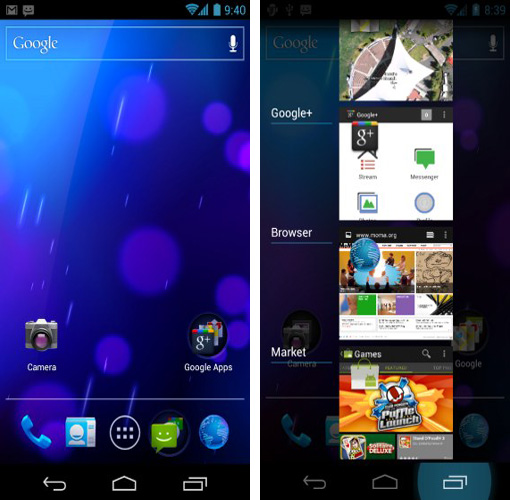
Android 4.0 brings a polished border that's more visual, more consistent and more interactive. Hardware buttons are replaced by virtual buttons in phones like Galaxy Nexus and Android 4.0 supports this change, while also allowing users to momentarily hide the buttons. Contextual menus are now displayed consistently at the top of the screen, so it's easier to find them. The menu button has been replaced by a fresh apps button that lets you switch to an app you've used recently. This feature was already accessible in Android, but the new interface uses thumbnails and it looks much better.

Just like in iOS, you can now create folders by dragging one app onto another app. You can also uninstall apps or disable pre-installed apps from the launcher. That's a good news for users because many carriers bundle applications that aren't very helpful.

Widgets are now resizable and can comprise more features, just like a regular app. The standard widgets are more powerful and you'll most likely use them more often instead of opening the corresponding apps.

You no longer have to unlock a phone to check the newest notifications, see the album art of the song that's at present playing or open the camera app. You can now react to incoming calls using text message templates and dismiss individual notifications. There's also Face Unlock, a simple way to unlock a device using facial recognition.

The soft keyboard has been enhanced and it offers better suggestions. There's a new spell-checker that underlines errors and suggests how you might fix them.

http://felix-googleblog-archive.blogspot.com/

Android's voice input engine lets you say a text without having to pause. "Users can speak continously for a extended time, even pausing for intervals if needed, and dictate punctuation to create correct sentences. As the voice input engine enters text, it underlines credible dictation errors in gray."

There's a new People app that integrates with Google+ and other social services, an updated calendar app that allows other applications to add events, visual voicemail in the phone app, a camera app that supports continuous focus, zero shutter lag exposure, stabilized image zoom, focus detection and single-motion panorama. The redesigned Gallery app focuses on functionality instead of eye-candy and makes it easier to edit photos and sort albums by time, location, people and tags.


Android lastly allows users to take screenshots without installing additional apps. The browser syncs bookmarks with Google Chrome, lets you save pages for offline reading and has an alternative to change the user agent of the browser so you can go to the desktop description of a page. Android's browser includes V8's Crankshaft update which improves JavaScript performance. "In benchmarks run on a Nexus S device, the Android 4.0 browser showed an improvement of almost 220% over the Android 2.3 browser in the V8 Benchmark Suite and more than 35% in the Sun Spider 9.1 JavaScript Benchmark." The tabs share the border used for switching to a recent app.

http://felix-googleblog-archive.blogspot.com/

The email app brings better contact auto-completion, templates, and integrated menu for accounts and labels, nested subfolders and searching across folders on the server. NFC is now used in Android Beam, a simple way to split contacts, apps, videos with compatible devices. "It's extremely simple and convenient to use — there's no menu to open, application to launch, or pairing needed. Just touch one Android-powered phone to another, then tap to send."

http://felix-googleblog-archive.blogspot.com/

The reference device for Android 4.0 is Galaxy Nexus, a Samsung smartphone that uses a 4.65" Contour Display (HD Super AMOLED) with a 1280 x 720 declaration, a dual core 1.2GHz processor and has support for LTE or HSPA+, depending on the carrier. The phone will be launched next month in the US, Canada, Europe and Asia. Obviously, you shouldn't wait for to be able to update Nexus S or other Android devices to ICS before the Galaxy Nexus launch.

http://felix-googleblog-archive.blogspot.com/


Here's a video that showcases most of the Android ICS features, followed by a Galaxy Nexus ad:


Wednesday, September 21, 2011

Google Wallet

Google originate an interesting way to launch the Google Wallet app for Android: as an over-the-air update for Sprint Nexus S 4G phones. Google Wallet makes use of the NFC chip from Nexus S phones and allows you to create credit card payments at physical stores using your Android smartphone.

"Google Wallet enables you to pay with your Citi MasterCard credit card and the Google Prepaid Card, which can be funded with any of your accessible plastic credit cards. As a thanks to early adopters, we're adding a $10 free bonus to the Google Prepaid Card if you set it up in Google Wallet before the end of the year," informs Google. The Google Prepaid Card is powered by MasterCard and Money Network and it's a provisional solution until you can add credit cards from other companies. Google says that the submission could add support for Visa, Discover and American Express cards in the future.


Google Wallet is more than a contactless payment explanation: it's a virtual wallet that could store information about your credit cards, coupons, loyalty cards, gift cards, tickets and much more. It's also a great chance for Google to integrate Google Offers and make it easier to use by allowing consumers to pay, redeem offers and earn allegiance points in a single step using their mobile phone. Google says that it doesn't have access to the list of products you buy, but this feature could be additional in the future.

While Google Wallet seems to be a suitable solution, many people might not use it because of privacy or security reasons. Google says that the payment credentials are stored in a separate chip called Secure Element and only official programs can begin transitions. Google Wallet users need to enter the PIN to confirm a payment, so someone who finds an Android phone can't use the app because he doesn't know the code.

Google's vision is to generate "an open commerce ecosystem" that will support many payment instruments, APIs that allow adding loyalty points, transferring offers, receipts and more. Google Wallet is Google Checkout's extension to offline payments and it's a big opportunity for Google to generate a successful payment system. PayPal will soon offer a similar service and Apple's iPhone 5 could contain a NFC chip, so Google Wallet will have a few competition.

Tuesday, June 14, 2011

Google Adds Voice Search, Visual Search and Results Prerendering

Two of the most significant Google mobile services: voice search and visual search will now be obtainable from your computer.

Voice search, a feature that's built into Android, also works in Google Chrome and allows you to search using your voice. Chrome additional support for the Speech Input API back in April and it's the only browser that implemented the API. Right now, Chrome's speech input feature is only accessible for English.

http://felix-googleblog-archive.blogspot.com/

"We first offered speech credit on mobile search, but you should have that power no matter where you are. You should never have to stop and ask yourself, 'Can I speak for this?' — it should be ever-present and intuitive. So we've further speech recognition into search on desktop for Chrome users. If you're using Chrome, you'll start to see a little microphone in every Google search box. Simply click the microphone, and you can speak your search," explains Google. The feature is steadily rolled out, so you may not see it yet.

Google Goggles is a full-fledged visual search engine that's attentive in a mobile application. But why do you have to buy a smartphone to use Google Goggles when you could just upload an image to Google and find related pages and images on the Web? "Search by Image" does more than TinEye, the "reverse image search engine" that lets you find an image on the Web.

http://felix-googleblog-archive.blogspot.com/

"Google uses computer visualization techniques to match your image to other images in the Google Images index and additional image collections. From those matches, we try to produce an accurate 'best guess' text description of your image, as well as find other images that have the same pleased as your search image. Your search results page can show results for that text description as well as linked images," mentions Google.

You can drag and drop an image to the search box, paste an image URL in the search box or click the camera icon and upload an image. Google generates a hybrid results page that shows both linked images and Web search results for the corresponding text query.


Google also a urbanized two extensions for Chrome and Firefox that let you right-click on an image and use it as a query. "With these extensions, you can begin a search on Google using pictures on the web. You can find out photos of places, learn more about art pieces, identify landmarks, and more."

While voice search and visual search are useful, the most inspiring search feature launched by Google today is Instant Pages. The new feature only works in Chrome 13+ (available in Canary/Dev Channel and soon in beta), but it will thoroughly improve your search experience. Chrome prerenders the top search result if it's likely that you will select it, so you no longer have to remain for the page to load. You might remember a feature called "prefetching" that was first supported by Firefox. Prerendering is a lot more influential than prefetching.


According to a Chrome developer, "prefetch is Firefox style prefetching of resources particular (just populating the cache). In Chrome, with prerender, we don't just download the URL specified, but render the whole page counting running all the JavaScript and downloading and rendering all the embedded resources."

For most users, Instant Pages will look like magic. They'll search for [nytimes] or [amazon], click the first result and be astonished to see that the page loads instantly. Google says that this feature saves 2-5 seconds on a characteristic search.

But Chrome's prerendering is not imperfect to Google searches. Any Web developer can use it by inserting a link element with a special value for the "rel" attribute. "Sometimes a site may be able to predict with sensible accuracy which link the user is most likely to click on next -- for example, the 'next page' link in a multi-page news article. In those cases, it would be faster and better for the user if the browser could get a head start loading the next page so that when the user clicks the page is already well on its way to being overloaded," suggests Google.

Tuesday, May 10, 2011

Android: Past, Present and Future

Google I/O's first keynote was all about Android and there were many imposing announcements.

Android stats continue to be surprising: 100 million activated Android devices, 400,000 Android devices activated every day, 200,000 apps in the Android Market, 4.5 billion apps downloaded from the Android Market, 310 Android devices.

The next major Android release is called Ice Cream Sandwich and the goal is to create a united operating system that runs on phones, tablets and TVs. Ice Cream Sandwich will be released later this year, but there's a Honeycomb 3.1 update that adds support for USB accessories and for Google TV. This summer, people who bought Google TV devices will be able to put in Android 3.1 and run apps from the Android Market

http://felix-googleblog-archive.blogspot.com/

Android users from the US can now rent movies from the Android Market. "You can decide to rent from thousands of movies starting at $1.99 and have them available across your Android devices — rent a movie on your home computer, and it'll be obtainable for viewing on your tablet or phone. You can rent from Android Market on the web today, and we'll be systematic out an update to Verizon XOOM customers beginning today. We'll start undulating out the update to Android 2.2 and above devices in the coming weeks," informs Google.

There's no music subscription service, but Google launched an invitation-only service that stores all your music on Google's servers and lets you stream it from roughly any computer and Android device.

http://felix-googleblog-archive.blogspot.com/

iPhone/iPod/iPad users can install the latest software updates for at least two years, but that's not always the case when it comes to Android devices. Some Android phones run outmoded software at launch and not all of them are updated to the latest version because phone manufacturers and carriers don't think that's really important. Google and some of the other members of the Open Handset Alliance (Verizon, HTC, Samsung, Sprint, Sony Ericsson, LG, T-Mobile, Vodafone, Motorola and AT&T) started to expand some guidelines for updating firmware. "To start, we're equally announcing that new devices from participating partners will be given the latest Android platform upgrades for 18 months after the device is first released, as long as the hardware allows," informs Google.


Google also urbanized Android Open Accessory, "which allows external USB hardware (an Android USB accessory) to interrelate with an Android-powered device in a special accessory mode. (...) Many previously released Android-powered devices are only able of acting as a USB device and cannot initiate connections with external USB devices. Android Open Accessory support overcomes this limitation and allows you to build accessories that can interact with an collection of Android-powered devices by allowing the accessory commence the connection."

Probably the most interesting announcement is Android@Home, a framework that allows Android devices to converse with home appliances and other devices. It's an ambitious project that could make home automation part of everyday life. That's also one of the main reasons why Google bought Android: bringing Google's software to new devices, finding new ways to use Google's information in each day life, creating an ecosystem of smart devices with standard features and APIs that make "the world's information" more useful.

Friday, April 29, 2011

Patents look for in Google's Sidebar

Google added a new quality to the sidebar: patents search. You no longer have to visit Google Patents to search the full text of the U.S. patent corpus since you can just click "patents" in the upright navigation menu. Here's an example.

http://felix-googleblog-archive.blogspot.com/

It may seem like a minor development, but this shows that Google's particular search engines will be available from the sidebar. At some point, you'll no longer have to visit Gmail to find a contact, Google Docs to find a file or Android Market to find an Android app.

Wednesday, January 12, 2011

Conversation Mode in Google Translate for Android

Google Translate's app for Android additional a feature that has previously announced by Google: discussion mode. The new option is experimental and it only works for English and Spanish, so it's more like an early preview. Conversation mode is a fancy name for making it easy to have a chat in two different languages.

http://felix-googleblog-archive.blogspot.com/

"In conversation mode, simply press the microphone for your language and start speaking. Google Translate will translate your speech and read the conversion out loud. Your conversation partner can then react in factors like regional accents, background noise or rapid speech may make it difficult to understand what you're saying their language, and you'll hear the translation spoken back to you. Because this technology is still in alph," explains Google.


The conversation is hypothetical to be fluid, but you still need to confirm that Google's voice credit system worked well and tap the "Reply" button to switch roles. Here's a demo that shows the new characteristic in action for English and German:

Sunday, January 9, 2011

Android Addresses UI Shortcomings

It's astonishing to see how much Android's user interface has distorted ever since Matias Duarte was hired by Google to get better Android. Matias has previously worked on Sidekick, Helio and Palm's WebOS, so Android is a perfect fit for him. In only 9 months, Matias Duarte and his team managed to talk to a lot of Android's UI shortcomings: a virtual keyboard that wasn't good enough, an uninspired border for multitasking, the hidden menus that required to click on a soft key to display them, rigid soft keys that were restricted to a single direction. Here's, for example, the steering bar that replaces the hidden menu for common actions:

In an Engadget interview, Matias says that Honeycomb is the future of Android in terms of user knowledge. His job is to make Android's interface so good that companies like HTC or Samsung don't have to spend so much time improving it. The stock user interface will raise the bar high enough to be more than a solid groundwork.

http://felix-googleblog-archive.blogspot.com/
You're not working on one product, you're not saying "we're one company, upright integrating and making one product and we're going to focus on one market and we're going to try and meet that mainly need." But instead, the idea is that there's a common problem that every company that wants to do well in making computing better, making computing mobile has and that's the basic platform problem. We're not only going to try to find a way to get everybody to benefit from it, we're going to do it for free. We're going to work on building this common tide that rises all boats.

It's attractive to think of Android as "the tide that rises all boats", a platform that accelerates mobile development not just for smartphones, but also for tablets, media players, digital cameras, TVs, cars, appliances and much more.

It's amazing to see how much Android's user interface has changed ever since Matias Duarte was hired by Google to improve Android. Matias has previously worked on Sidekick, Helio and Palm's WebOS, so Android is a perfect fit for him. In only 9 months, Matias Duarte and his team managed to address a lot of Android's UI shortcomings: a virtual keyboard that wasn't good enough, an uninspired border for multitasking, the hidden menus that required to click on a soft key to display them, inflexible soft keys that were limited to a single orientation. Here's, for example, the navigation bar that replaces the unseen menu for common actions:


In an Engadget interview, Matias says that Honeycomb is the future of Android in terms of user experience. His job is to make Android's border so good that companies like HTC or Samsung don't have to spend so much time improving it. The stock user interface will raise the bar high sufficient to be more than a solid foundation.

You're not working on one product, you're not saying "we're one company, upright integrating and making one product and we're going to focus on one market and we're going to try and meet that particularly need." But instead, the idea is that there's a common problem that every company that wants to do well in making computing better, making computing mobile has and that's the fundamental platform problem. We're not only going to try to find a way to get everybody to benefit from it, we're going to do it for free. We're going to work on building this common tide that rises all boats.

It's attractive to think of Android as "the tide that rises all boats", a platform that accelerates mobile growth not just for smartphones, but also for tablets, media players, digital cameras, TVs, cars, appliances and much more.

Wednesday, January 5, 2011

Honeycomb: Android for Tablets

Google has by chance made public a YouTube video that shows Android 3.0 in action. It's a completely new boundary for tablets that borrows a lot of thoughts from BumpTop, the 3D desktop software acquired by Google last year.

Engadget says that the new interface "looks more or less not anything like Android". You might think it's a new operating system. The video mentions that this is "the next age band of Android" and that's built completely for tablets.

http://felix-googleblog-archive.blogspot.com/
Google has listening carefully on improving the user interface and Android 3.0 comes with fluid home screens, better app switching, browser tabs, video chat, dynamic app shortcuts and new versions of Google's Android applications that take benefit of the bigger screen.

It seems that the Android tablets that will be launched in the coming months will have imposing hardware and an efficient operating system that looks dramatic, so they're balanced for success.

Thursday, December 30, 2010

Top Google Apps in 2010

Here's a subjective list of Google services that were launched or were significantly improved in 2010:

10. Google Scribe - a examine that shows auto complete suggestions as you type. It will almost certainly become as accepted as Google Suggest and Google Translate once its included with other services.

9. Voice Actions for Android - an submission that lets you control your phone using your voice. You can call your contacts, send email, get instructions, listen to music, write notes and go to a website.

8. Gmail added lots of business-related features (Priority Inbox, email delegation, turning off conversation view), better Gmail Chat (calling phones, video chat for Linux), added a new contact manager, more ways to join files, Gmail for iPad, Buzz integration, search auto complete, You Tube previews and rich text signatures.

7. Google Buzz - in spite of the initial privacy brouhaha, Google Buzz is the most excellent Google service released in 2010. Even if it's less than one year old, Buzz already has an imposing set of features, a powerful API, it's included with many services and has a cool factor that's lost from other Google social products. unluckily for Google, Buzz is not yet very popular.

6. Blogger additional a lot of significant missing features: comment management, comment spam filtering, dynamic templates, a new post editor, better post preview, real-time stats, static pages and much more.

5. Google Docs - a new document editor, earlier Google Spreadsheets, a collaborative drawing editor, a new equation editor, mobile editing, a more consistent interface, uploading any kind of files.

4. Google Maps - vector-based maps for Android, Google Latitude for iPhone, a new local look for service (Google Places), social local business reccomendations, biking directions, walking navigation, Google Earth as a tab in Google Maps, search suggestions.

3. Chrome - 5 major versions released, support for Mac and Linux, a basic interface, faster browsing, autofill, sync, Google Translate integration, bundled sandboxed plugins for Flash and PDF files, Chrome Web Store.

2. Google Search has changed a lot this year and there were loads of user interface changes: from Google Instant to Instant Previews, from interactive doodles to custom backgrounds for the homepage, from perpendicular navigation menus to a consistent interface for most Google search services. Google also launched a completely new border for image search that lets you explore more images and a new search index with real-time updates.

1. Android - two significant releases (Froyo, Gingerbread), huge growth (from 1.4 million smartphones sold in the third quarter of 2009 to 20.5 million phones one year later - according to Gartner) and a lot of original devices, including tablets, TVs, consoles, media players and e-book readers. It's almost certainly the fastest growing product released by Google.

Thursday, November 18, 2010

You Can't Search for Android from an Android Phone

This is a really a strange bug. If you use Google to search for the [android], [android market] or [android phone] from an Android phone, you won't get any result. Google only shows ads related to your query and a standard message: "Your search did not match any documents".

It's not clear if this is an Android bug or a Google search bug, but it's certainly not an Easter egg. If you don't have an Android phone, try this page to use the Android-optimized interface.

http://felix-googleblog-archive.blogspot.com
Update: it seems that the same bug affects Google's iPhone interface and there are many other queries that don't return any result. "When signed into the mobile site, I see some search results, but not for all queries. I'm on a Nexus One. In the classic interface, everything works fine," says a Google user. "I'm having the same issue on an iPhone 4. No results for super common terms, but images and location searches are unaffected," confirms another user.

Tuesday, October 19, 2010

Steve Jobs on Android's Fragmentation

Apple's CEO says that Android is fragmented and that the open vs. closed dilemma is not important as long as Apple's proprietary mobile operating system manages to provide a better user experience.

"Many Android OEMs install proprietary user-interfaces to differentiate themselves from the commodity Android experience. The user is left to figure it all out. Compare this with iPhone where ever handset works the same. (...) We think the open vs closed is just a smokescreen to try and hide the real issue, which is: What's best for the customer? Fragmented vs. integrated. We think Android is very very fragmented and becoming more fragmented by the day."

Steve Jobs is right, the real question is: What's best for the customer? Some people like to have options. Not everyone likes iPhone's form factor, iPhone's interface and some may even want a hardware keyboard, a custom virtual keyboard or a weather widget. Android is a diverse ecosystem and there's a lot to learn until Google, hardware manufacturers and all their partners manage to come up with revolutionary phones, consistent interfaces and integrated experiences. Android is just an opportunity to innovate, it's not a complete package. Google chose a non-restrictive license for Android to encourage innovation, even if that meant less control and more fragmentation.

Mobile phones are more personal than computers and I don't think we'll live in a world where every smartphone user will choose an iPhone. There's always a trade-off and not everyone wants a perfect phone if that means they'll have to change their definition of a perfect phone.


Monday, October 4, 2010

More People Can Buy Apps from the Android Market

If there's one thing that Google should do to improve the Android, it's developing a better Android Market. Google's app store has a lot of limitations, it still doesn't have a desktop interface, applications are priced in multiple currencies, and it's not easy to find new applications.

Android Developers Blog announced that people from 18 additional countries will be able to buy Android apps. The new countries are: Argentina, Belgium, Brazil, Czech Republic, Denmark, Finland, Hong Kong, India, Ireland, Israel, Mexico, Norway, Poland, Portugal, Russia, Singapore, Sweden, and Taiwan. Google says that paid apps will be available over the next two weeks. Android Market's paid apps will be available in 32 countries and Google promises to bring them to even more countries in the coming months.

Now that many other companies develop Android app stores, Google has to improve the Android Market if it doesn't want to see too many Android phones without the market.

http://felix-googleblog-archive.blogspot.com

Thursday, August 26, 2010

Android Market and Piracy

Google has recently released a licensing service for the Android applications that is supposed to make it more difficult to the pirate paid apps. The service is not yet part of the operating system and it works by sending a query to the Google's servers in order to determine if the user has bought an application.

Android Police found that it's quite easy to the circumvent Google's verification, especially if the application's code is not obfuscated. "Because the License Verification Library is not part of the Android OS, an app developer needs to package it with the app that uses it, making it an easier patch target, without requiring root access. (...) The method is so simple, even a novice programmer could write a script to automatically patch most apps."

Google's Tim Bray responded by saying that "the first release shipped with the simplest, most transparent imaginable sample implementation," which didn't focus on security. He recommends developers to obfuscate the code and to use other implementations. Tim Bray also says that "the best attack on pirates is to make their work more difficult and expensive, while simultaneously making the legal path to products straightforward, easy, and fast. Piracy is a bad business to be in when the user has a choice between easily purchasing the app and visiting an untrustworthy, black-market site."

Tim Bray's answer is ironic, if you think about it. Google's Android Market lets you install paid applications only if you are in one of the 13 supported countries. The "legal path" is neither "straightforward, easy, or fast" if you don't live in one of the 13 countries that are supported. Maybe instead of focusing on developing anti-piracy services, Google should add more locations to the paid Android Market.

http://felix-googleblog-archive.blogspot.com/

Monday, August 2, 2010

Send Links from Firefox to an Android Phone

Android 2.2 has a cool service for sending the messages to phones: Android Cloud to Device Messaging. "The service provides a simple, lightweight mechanism that servers can use to tell the mobile applications to contact the server directly, to fetch the updated application or with user data."

A simple way to use this service is to send a link from your browser to an Android device. Chrome to Phone is a Chrome extension that makes this much possible, assuming that you also install an Android application on your phone. The extension has been recently updated and you can use it to the send links, phone numbers and text from the web pages.

There's also an unofficial Firefox extension called "Send to phone", which offers with similar features. The Firefox extensions adds an option to the contextual menu, so you don't have to click on the toolbar button to send some of the text.

http://felix-googleblog-archive.blogspot.com
Some things you can try:
* send a Google Maps link and the Google Maps app from your phone should handle it
* send a link to a YouTube video and the video should start playing on your phone
* copy a phone number from a web page and send it to your phone
* copy a short text from a web page (<1KB) and send it to your phone's clipboard.

Note that you need a device that uses the Android 2.2 (Froyo), which is officially available for Nexus One, HTC Evo and HTC Desire. Motorola Droid will be updated to Froyo starting from the next week, while the other phones will be updated in the coming months.

Wednesday, June 9, 2010

Google Maps Navigation for Canada and 10 European Countries

Google Maps Navigation for Android is now available for Canada, Austria, Belgium, Denmark, France, Germany, Italy, the Netherlands, Portugal, Spain, and Switzerland, in addition to the 3 countries that were already supported: US, UK and Ireland. It's interesting to notice that Google still uses data from Tele Atlas for all the countries supported by Google Maps Navigation, except for the US and Canada.

http://felix-googleblog-archive.blogspot.com
"Google Maps Navigation is an Internet-connected GPS navigation or 'satnav' system that provides turn-by-turn voice guidance as a free feature of Google Maps. Google Maps Navigation (beta) with Search by voice is available in version 4.2 of Google Maps, on Android devices 1.6 and higher," explains Google.

Free turn-by-turn navigation could be an important reason why people choose a mobile phone, so Google and Nokia try to make the most of Google Maps Navigation for Android and Ovi Maps for Symbian. Most likely, in the near future, all smartphones will include a free application for navigation.

In other related news, Google Search by Voice is now available for German, Italian, Spanish and French. Search by voice is an important feature of the Quick Search Box app for Android, Google Mobile App for iPhone and Blackberry. The nice thing is that you don't have to download an update for none of the applications, as the new languages are automatically recognized.

Friday, May 28, 2010

Adobe Reader for Android

After releasing Flash Player for Android, Adobe launches a PDF reader for Android. The applications is available in the Android Market and it can be installed only if your phone runs Android 2.1 or later and it has at least 256 MB of RAM and a 550 MHz processor.

Nexus One already comes with a document viewer based on Quickoffice, but the application doesn't do a great job at previewing PDF files. Adobe Reader for Android opens PDF files much faster than Quickoffice and it has a better zooming feature.

"Adobe Reader for Android offers multi-touch gestures, like pinch-and-zoom, as well as double-tap-zoom, flick-scrolling and panning. We've also added a reflow mode, which will take text-heavy documents with wide margins, and automatically wrap the content for easy viewing on smaller screens," explains Adobe.

The application doesn't include basic features like search or support for password-protected files, but it's snappy, documents are readable and the applications opens in full screen. There aren't many free PDF viewers for Android and Adobe's application is clearly the best right now.

http://felix-googleblog-archive.blogspot.com

Tuesday, May 25, 2010

Send Links from Google Chrome to an Android Phone

One of the most interesting APIs in Android 2.2 allows developers to create applications that can receive messages from servers. "Android Cloud to Device Messaging (C2DM) is a service that helps developers send data from servers to their applications on Android devices. The service provides a simple, lightweight mechanism that servers can use to tell mobile applications to contact the server directly, to fetch updated application or user data."

To try the new APIs, you can install an Android app and a Chrome extension that let you send a link from the browser to your phone and automatically open the URL in Android's browser. Install the Android application, register your device and enable "launch browser/maps directly". Then install the Chrome extension, click on the icon and log in to the same Google account used in Android. Now you can send links to your phone by clicking on a button in Google Chrome.

http://felix-googleblog-archive.blogspot.comThe application requires Android Froyo, which is only available for Nexus One at the moment.