Monday, May 30, 2011

Using search patterns to track dengue fever

What does baseball have in frequent with gazebos? We’re not sure, except for that people search on Google for both terms in similar patterns. Last week we introduced Google Correlate, an experimental tool enabling researchers to model real-world performance using search trends. We’ve heard from many researchers who want to mine this data for new discoveries about economics and public health—much like we planned Google Flu Trends to give an early warning about flu outbreaks. We hope they’re able to make useful discoveries with Google associate.

While building Google Correlate, we used it to create an early warning system for another significant disease. Google Dengue Trends in Bolivia, Brazil, India, Indonesia and Singapore provides an extra surveillance tool for a disease that affects about 100 million people each year. Dengue is a virus spread through mosquito bites that creates symptoms counting high fever, severe headache and pain, rash and mild bleeding. There is no vaccine or treatment, so public health efforts are mainly focused on helping people take steps to prevent being infected with the disease.

Singapore has an remarkably timely surveillance system for dengue, but in many countries it can take weeks or months for dengue case data to be collected, analyzed and made available. During the dengue outbreak at last year’s Commonwealth Games, we discussed the need for timely dengue information. With help from Professor John Brownstein and Emily Chan from HealthMap, a program at Children’s Hospital Boston and Harvard Medical School, we were able to generate our system. Using the dengue case count data provided by Ministries of Health and the World Health Organization, we’re able to build a model that offers near real-time estimates of dengue action based on the popularity of certain search terms. Google Dengue Trends is automatically rationalized every day, thereby providing an early indicator of dengue activity.

The methodology for this system is the same as that for Google Flu Trends and is outlined in a newly published article in PLoS disused Tropical Diseases.

We hope the early warning provided by Google Dengue Trends helps health officials and the public arrange for potential dengue outbreaks. For those who live in places where dengue is present, remember to go after the advice of health officials to prevent infection by wearing mosquito revolting and emptying any containers that lure mosquito larvae by meeting standing water.

Friday, May 27, 2011

Our 2011 EMEA Faculty Summit

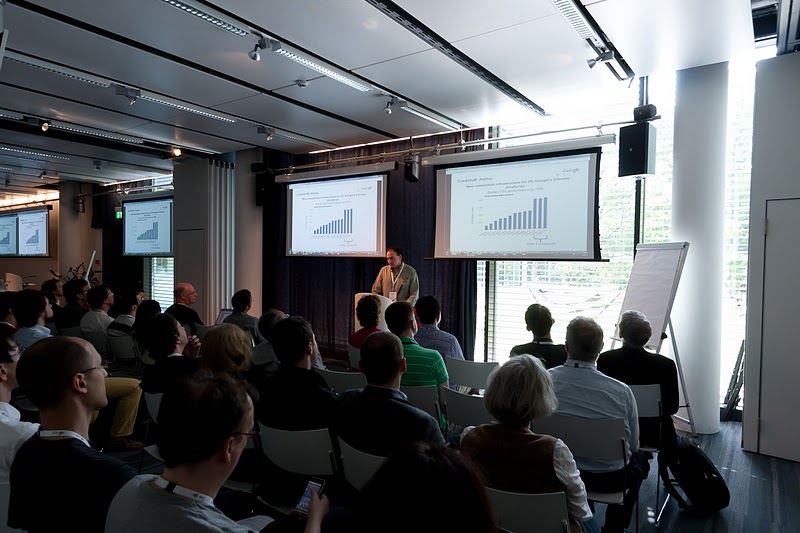
Earlier this month, we held our fourth Europe, Middle East and Africa (EMEA) Faculty peak at our Zurich office, Google’s largest engineering center in the region. This was EMEA’s biggest Faculty Summit to date, with some of EMEA’s foremost computer science academics (103, to be exact) from 73 universities on behalf of 28 countries, plus more than 60 Googlers in attendance. Over the course of three days, participants chose from 48 different sessions, technical streams and tech talks (given by both Googlers and academics) that enclosed a variety of computer science topics including privacy, software engineering and usual language processing.

http://felix-googleblog-archive.blogspot.com/

The Faculty Summit is a chance for us to meet with computer science academics to talk about operations, regional projects and ways we can join forces via our our university programs. These programs comprise our Focused Research Awards, which, to date, are nearing €3.7 million with recent awards in Europe given to researchers exploring privacy, fact discovery, test amplification, optimization and security, among other topics. We also have an academic research plan to understand market algorithms and auctions, the Google European Doctoral Fellowship and the all-purpose research awards program.

This year’s jam-packed agenda incorporated a welcome address by Yossi Matias, senior director and head of Google’s Israel Research and Development Center, covering Google’s engineering activity and new innovations in EMEA; a presentation by Alfred Spector, vice president of research and special initiatives, on our advance to research and innovation; and a presentation by Nelson Mattos, vice president of EMEA product and engineering, on exciting developments and opportunities in Africa and the Middle East. David Konerding presented Google’s Exacycle for Visiting Faculty, a grant program for high-performance, CPU-intensive computing where we’ll award up to 10 capable researchers with at least 100 million computing core-hours each, for a total of 1 billion core-hours. Professor Claudia Eckert, a guest visiting from the Technical University of Munich, gave an insightful appearance on security, privacy and the future of the internet.

We also held one-on-one break-out sessions where academics and Googlers could meet confidentially and discuss topics of personal interest, such as how to expand a well-constructed research award proposal, how to apply for a sabbatical at Google or how to gain Google support for a discussion in a applicable research area.

http://felix-googleblog-archive.blogspot.com/

The Summit provides a great opportunity to build and make stronger research and academic collaborations. Our hope is to drive technology forward by fostering equally beneficial relationships with our academic colleagues and their universities.

Stay tuned for more facts about the North America Faculty Summit in New York, July 13-15.

Thursday, May 26, 2011

Coming soon: make your phone your wallet

Today in our New York City office, along with Citi, MasterCard, First Data and Sprint, we gave a demonstration of Google Wallet, an app that will make your phone your wallet. You’ll be able to tap, pay and save using your phone and near field communication (NFC). We’re field difficult Google Wallet now and plan to release it soon.

Google Wallet is a key part of our ongoing effort to get better shopping for both businesses and consumers. It’s aimed at making it easier for you to pay for and save on the goods you want, while giving merchants more ways to offer coupons and devotion programs to customers, as well as bridging the gap between online and offline commerce.

http://felix-googleblog-archive.blogspot.com/

Because Google Wallet is a mobile app, it will do more than a usual wallet ever could. You'll be able to store your credit cards, offers, loyalty cards and gift cards, but without the bulk. When you tap to pay, your phone will also routinely redeem offers and earn loyalty points for you. Someday, even things like boarding passes, tickets, ID and keys could be stored in Google Wallet.

At first, Google Wallet will hold both Citi MasterCard and a Google Prepaid Card, which you’ll be able to fund with roughly any payment card. From the outset, you’ll be able to tap your phone to pay wherever MasterCard PayPass is accepted. Google Wallet will also sync your Google Offers, which you’ll be able to redeem via NFC at participating SingleTap™ merchants, or by performance the barcode as you check out. Many merchants are working to put together their offers and loyalty programs with Google Wallet.

http://felix-googleblog-archive.blogspot.com/

With Google Wallet, we’re building an open commerce ecosystem, and we’re setting up to develop APIs that will enable addition with numerous partners. In the beginning, Google Wallet will be well-suited with Nexus S 4G by Google, available on Sprint. Over time, we plan on growing support to more phones.

This is just the start of what has already been a great exploit towards the future of mobile shopping. We’re extremely excited and hope you are, too.

Wednesday, May 25, 2011

Inside the Big Tent

At our European Zeitgeist event, held yearly near London, we usually erect a large marquee for a partner dinner and entertainment. This year we wondered if there was something else we could do with the space once Zeitgeist was over. In that instant, the Big Tent was born.

Canvas aside, the term "big tent" has, of course, a political connotation. Wikipedia defines it as "seeking to draw people with diverse viewpoints...does not need adherence to some ideology as a criterion for membership." That just about sums up the idea at the back last week’s Big Tent conference, which focused on debating some of the hot issues linking to the internet and society.

We invited the advocacy groups Privacy International and Index on Censorship—both of whom have criticised Google in the past—to partner with us in staging the debates, and wanted diverse viewpoints among the speakers and the delegates.

Topics on the agenda included: what was the role of technology in the revolutions in the Middle East? What are the limits of free speech online? Do we need tougher privacy laws or are we in danger of stifling innovation? Can technology and access to in order be used to help prevent conflict?

The result was a motivating day of debate featuring the likes of Big Brother television producer Peter Bazalgette, Mumsnet founder Justine Roberts and the U.K. Culture Secretary Jeremy Hunt alongside Googlers including Eric Schmidt, Google Ideas’ Jared Cohen and the Egyptian activist Wael Ghonim, and a highly occupied and knowledgeable audience of NGOs, policy advisers, tech businesses and journalists.

You can watch highlights on YouTube and see happening feedback on Twitter. We hope to bring the Big Tent to other regions over the coming year.

No More Offline Gmail in Google Chrome

Chrome 12, the upcoming version of Google's browser which is likely to be free today, removes a useful feature: the built-in Gears plugin. While most Google services dropped support for Gears and detached offline way in, Gears is still being used in Gmail. Google no longer maintains Gears, which is now legacy software, and focuses on implementing offline hold up using HTML5.

But why remove Gears hold up without implementing the features using HTML5 first? Google says that you'll only need to wait for a few weeks or you can still older versions of Firefox, Internet Explorer and mail client such as Thunderbird or Outlook.

http://felix-googleblog-archive.blogspot.com/

"The new Gmail Offline ability is targeted for delivery as a Chrome browser web app this summer. As we move the Gmail Offline capability to a Chrome web app, we will denounce the Google Gears-based Gmail Offline. This coincides with the version 12 release of the Google Chrome browser which no longer supports Gears. As a result, Google Gears-based Gmail Offline will no longer work with the Chrome browser as of Tuesday May 24, 2011. Google Gears-based Gmail Offline will carry on to work in Internet Explorer 8 and Mozilla Firefox 3.6," explains Google.

It's not the best thing to do after believable users to switch to Chrome and use Web apps, but it's just a temporary issue. If the HTML5 offline Gmail wasn't ready to be free, removing Gears from Chrome could have been delayed.

Monday, May 23, 2011

Music Album Filtering in Google Video

Google started to learn more about music. After civilizing the Web search results for music videos by adding metadata, Google additional the same enhancements to Google Video. Now you can even find a list of popular albums when you search for an artist. Select one of the albums and you'll limit the results to the songs from the album. The nice thing is that Google's algorithms make sure that the results are varied and songs aren't frequent too often.

http://felix-googleblog-archive.blogspot.com/

http://felix-googleblog-archive.blogspot.com/

“I don't think the marbles will be as bad as people fear, because they be liable to occur at the exits of high-speed corners, and Monaco is generally quite a low-speed track, so I don't think we'll see the build-up that we saw at somewhere like Turkey's Turn Eight, for example.

“I'm previously looking forward to it.”

Sunday, May 22, 2011

How Google Docs Killed GDrive

"In The Plex", Steven Levy's recently launched book about Google, has an attractive story about GDrive, an online storage service urbanized by Google. People first found about GDrive from a leaked Google document, back in 2006. GDrive (or Platypus) turned out to be a service used by Google employees that offered many imposing features: syncing files, viewing files on the Web, shared spaces for collaborating on a document, offline access, local IO speeds. But Google required to launch GDrive for everyone.

At the time [2008], Google was about to launch a project it had been mounting for more than a year, a free cloud-based storage service called GDrive. But Sundar [Pichai] had finished that it was an artifact of the style of computing that Google was about to usher out the door. He went to Bradley Horowitz, the executive in charge of the project, and said, "I don't think we need GDrive anymore." Horowitz asked why not. "Files are so 1990," said Pichai. "I don't think we need files anymore."

Horowitz was stunned. "Not need files anymore?"

"Think about it," said Pichai. "You just want to get in order into the cloud. When people use our Google Docs, there are no more files. You just start restriction in the cloud, and there's never a file."

When Pichai first proposed this concept to Google's top executives at a GPS—no files!—the reaction was, he says, "skeptical." [Linus] Upson had one more characterization: "It was a withering assault." But finally they won people over by a logical argument—that it could be done, that it was the cloudlike thing to do, that it was the Google thing to do. That was the end of GDrive: shuttered as a relic of obsolete thinking even before Google released it. The engineers operational on it went to the Chrome team.

In 2009, Google Docs in progress to store PDF files and one year later you could store any type of file in Google Docs. The service still doesn't offer a way to sync files. Even if GDrive was never released, Google Docs inherits most of its features. The main difference is that you no longer have to be troubled about file formats because you can open and edit documents in Google Docs.